Problem
Small business owners faced a painful contradiction: they were generating more financial data than ever, but understanding less of it. Most spent upwards of five hours weekly manually reconciling information across disconnected banking platforms, accounting tools, and spreadsheets — none of which were designed to work together or speak to a non-financial audience.
The consequences were tangible. Without clear, accessible insight, most small business owners were making critical financial decisions based on instinct rather than data. The information existed — it was buried in complexity that demanded expertise most owners didn't have time to develop. The result was a business population operating partially blind, where every financial decision carried outsized risk.
The core design challenge was not a lack of data. It was a lack of legibility.
FINTECH
Senior Product Designer
YEAR
2023


PROCESS
The central tension throughout this project was one every designer working with data-heavy clients will recognize: the stakeholder who views nothing as expendable. Every metric, every module, every data point was positioned as essential. Nothing was negotiable. The design challenge wasn't just visual — it was argumentative. How do you create clarity when the client's instinct is to show everything?
The answer was sequencing, not subtraction.
Rather than removing information, the platform was designed around a three-level progressive disclosure model that made complexity feel approachable without hiding it.
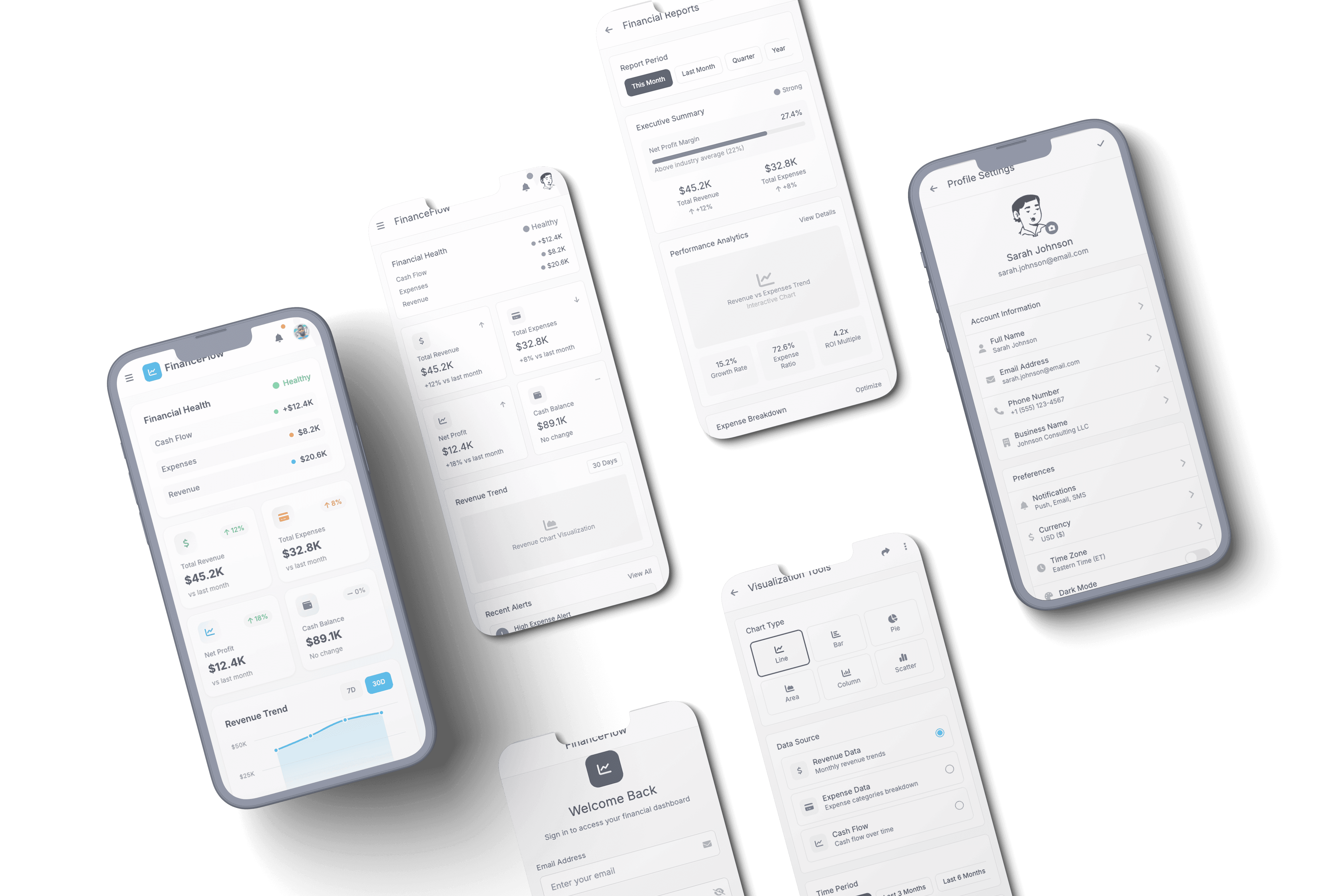
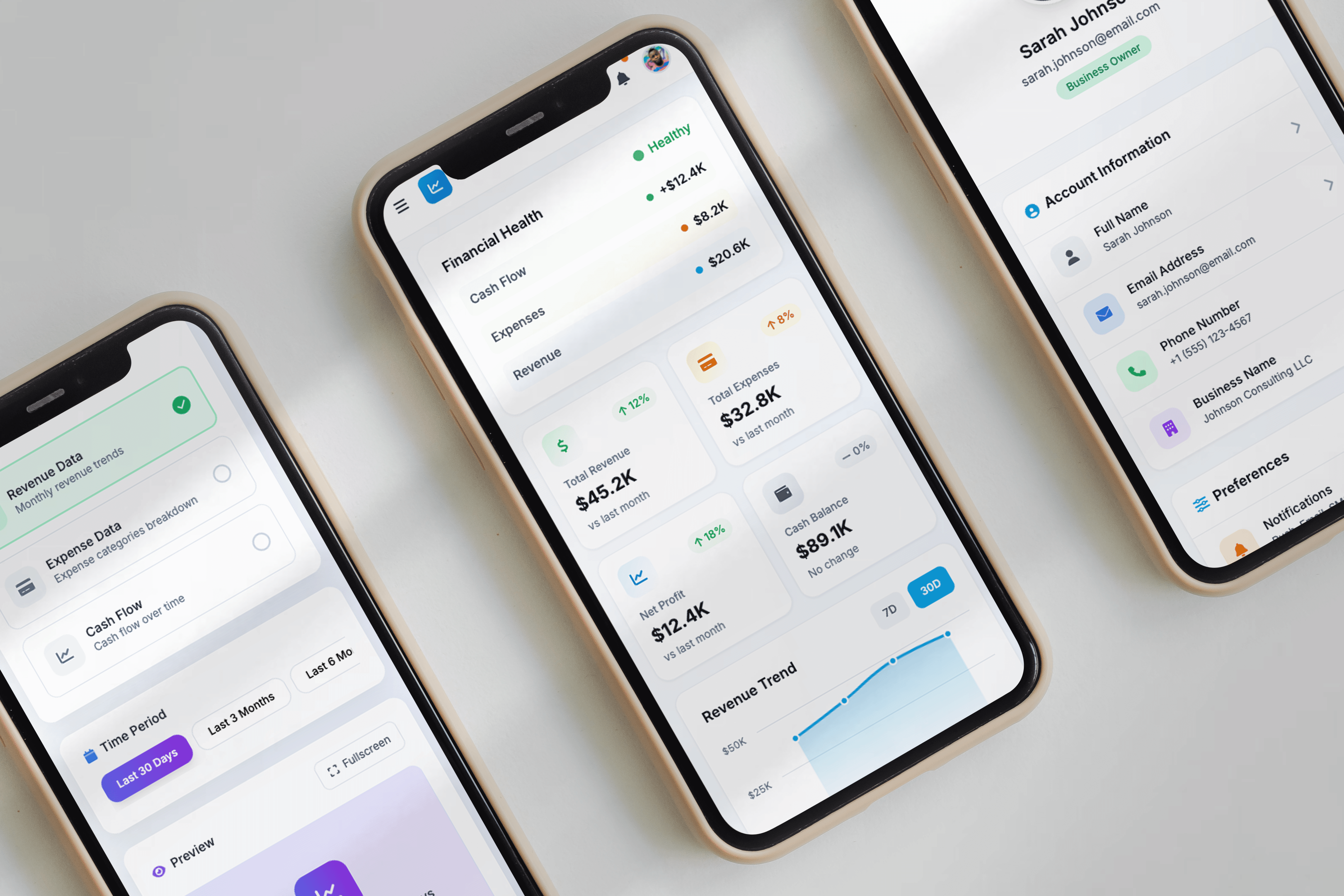
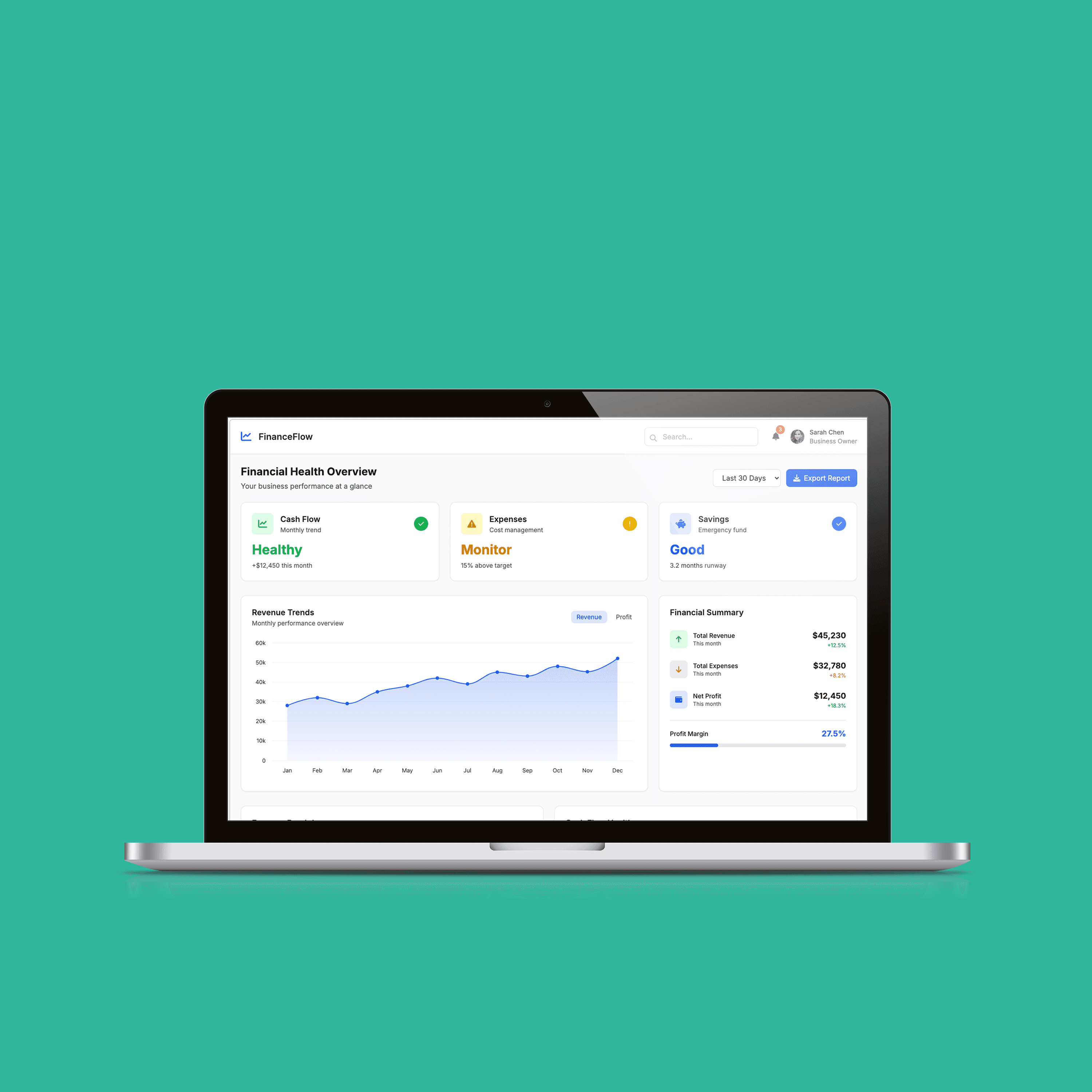
Level one — Status at a glance. The dashboard leads with three financial health cards: Cash Flow, Expenses, and Savings. Each resolves to a single plain-language verdict — Healthy, Monitor, Good — color-coded green, amber, and blue, respectively. A business owner can assess the state of their finances in under five seconds without reading a single number.
Level two — Trend context. For users who want to understand the direction of their business, not just its current state, the Revenue Trends chart shows monthly performance over a full year with a Revenue/Profit toggle. The choice of a line chart over a bar chart was deliberate — line charts communicate trajectory and momentum more naturally than discrete comparisons, which matters when the goal is confident decision-making.
Level three — Precise detail. The Financial Summary panel on the right consolidates total revenue, total expenses, net profit, and profit margin into a single scannable column. This is the layer for users who need exact figures — but it's positioned as supporting context, not the first thing the eye lands on.
Supporting this hierarchy was a time filter ("Last 30 Days") and an Export Report function — both small but meaningful signals that the platform was designed for action, not just observation. Users weren't meant to simply view their data. They were meant to do something with it.
Data Visualization Decisions
The dashboard's visual language was built around one principle: reduce the cognitive distance between data and decision.
The three-status health card system at the top of the dashboard was the most deliberate choice in the entire interface. Traditional financial dashboards lead with numbers — balances, totals, percentages. FinanceFlow leads with verdicts. Green means keep going. Amber means pay attention here. Blue means stable. A business owner who opens the app at 7am before a full day doesn't need to interpret — they need to know.
The Revenue Trends chart was intentionally kept minimal. No grid clutter, a soft area fill beneath the line to reinforce upward trajectory, and labeled data points only at key intervals. The toggle between Revenue and Profit views was added specifically to address the "we need to show everything" tension — rather than displaying both lines simultaneously and creating visual noise, the toggle lets users control what they're analyzing without the chart becoming unreadable.
The Financial Summary panel was a direct response to the power user need — the business owner or their bookkeeper who wants exact figures and percentage changes. Separating this into its own panel rather than embedding numbers throughout the dashboard kept the primary status layer clean while still serving the detail-oriented use case.
Color was used semantically throughout, never decoratively. Green signals financial health. Amber signals areas needing attention. Red — used in the summary panel for expense figures — signals outflow without implying crisis. This system meant users could develop an intuitive relationship with the interface over time.

Outcome
FinanceFlow remained a concept project, which placed the burden of validation on the design rationale itself rather than live user data. The decisions made throughout — the status card system, progressive disclosure model, and semantic color language — were grounded in established principles of data visualization and financial UX, applied specifically to the cognitive needs of time-pressed small business owners.
The work demonstrated that clarity at scale isn't achieved by showing less — it's achieved by sequencing information so users always know exactly where they are and what to do next. That principle translates directly to any data-heavy environment where the gap between information and action is the primary design problem to solve.